My Vison:
TRACE arose out of inspiration from a few sources, most notably the game "Metal Garden" as well as the Halo franchise, and a host of aspects from a lot of 2000's games. My vision for the game is a platformer/movement shooter with a 2000's retro style that takes bits and pieces from a lot of my favorite games. I want it to have a lot of things, like a subtle and compelling story about loneliness through great distance and time, a dual storyline structure with two seperate characters, and the massive scale of levels like seen in games like Titanfall 2, Metal Garden, Halo, and more. Megastructures are something that has fascinated me ever since I was a kid playing Halo:CE for the first time and being amazed at the concept of a ringworld. There's something about that scale that really draws me in, and it isnt just the physical size, but also the scale of time. Something I used to think about when I was a kid was how long would it take to walk the inner circumference of a Halo ring? Like... not days, surely. Weeks? Months? Could I spend a year or years walking in the same direction on the same structure, built by hands that thought of years like I think of minutes? Could I live here, and never run out of places to see? Something I really want to convey in the story of TRACE is how moving through a structure the size of the one in TRACE takes incredibly long and is so lonely. It's like in the manga BLAME!, where the main character is an android trying to get the edge of a similar megastructure. He walks for thousands of years, encountering little pockets of civilization along the way. But by the time he's reached the next pocket of people, it's been hundreds or thounsands of years. Most of his story isn't the story... it's the gaps between. The thousands of years of loneliness he endures for the sake of finding the edge.
Elevator Pitch:
TRACE is a 3d platformer/movement shooter that features two playable characters with different gameplay experiences in a level-based structure. TRACE takes place inside a megastructure of immense size with level design that places an emphasis on massive scale. TRACE has a subtle but compelling story about loneliness and connection over vast distances and time; the story is shown, not told.
The World:
TRACE takes place inside a small fraction of a much larger megastructure, the region being about 1,200,000 kilometers across. The origins of the megastructure are not entirely clear, but it is ancient, old enough that life has adapted to live inside. Aside from the characters, the region is primarily inhabited by basic maintenance robots and machines, and some small flora and fauna surviving where the lights are bright enough. The structure is mostly made of metal and concrete, and is not built at a scale designed for humans to traverse; walls hundreds of meters tall and hallways hundreds of kilometers long are the norm, so are rooms that could fit small planets in them. Plant and animal life is scarce, what little there is is confined to the massive rooms that take up the empty space far from major areas, and often has become specialized for life inside that single room, never leaving. The region features a few key areas and points of interest that serve as playable levels, notably being: A mining sector, busy at work dismantling a planetoid for resources. A logistics sector, millions of kilometers of warehouses and sorting machines. An active construction area. An industrial sector, being countless refineries and factories turning materials from the mining sector into useable products. A CPU sector, which houses the AI that supervises the region (more on that). And many more areas as I come up with them. The key areas of the regions are directly connected by massive hallways that serve as highways for resources, but the space between the key areas and highways is not as ordered. Those spaces are where you'll find the millions of kilometers of empty rooms and hallways that have little to no use or are simply structural.
The Characters:
All the characters in TRACE are AIs in some form, life as you and I would know it is few and far between, the megastructure is not built with life in mind. Though as mentioned earlier, there is some life in the forgotten gaps between spaces, in the rare spaces where life support was implemeted during construction and maintained simply because it always has been. There is no sentient life in the region though aside from AIs. Oh, this is relevant: Architect and Hunter, two characters I'll be going over, are not robots in the traditional sense, their AI, their digital soul or whatever, is not contained in their body but rather within the megastructure itself. Their bodies are called frames, and a frame is basically just a puppet for the AI to control so it can do its work. This means the frame is expendable and the AI remains intact, being able to learn from even fatal mistakes. (Also it's a diegetic respawn/checkpoint system). I'll be going over what makes the characters unique and some of their abilites and mechanics.
Architect
Architect (I like to call him Archie) is an advanced maintenance AI designed with intelligence for versatile tasks in a range of environments. He is relatively young in the grand scheme of the megastructure (really need a name for this place), having been operational for about 100,000 years. In his long life of service and many travels he has developed an identity. Architect is curious about the function of many things in the structure, especially the sparse pockets of plant and animal life that seem to serve no function at all. While he works and during his travels, he finds some sense of satisfaction in piecing together the history and purpose of the things around him. His frame is humanoid and boxy, built to be versatile and sturdy. He has a small kit, a few tools that help him with maintenance, and a jetpack built into his frame that enables traversal of the many massive environments. In gameplay, his tools are both for solving puzzles/completeing objectives as well as combat.
Hunter
Hunter is an extremely young AI, actually created during the storyline of TRACE. Hunter is designed specifically to combat and eradicate the organic infestation threatening the region (see the narrative section for more on that). Still being hot off the figurative press, Hunter's identity is his work. He is rigid to his instructions and sees his efficiency as his only goal. Hunter's frame is highly specialized for rapid combat. It isn't one-to-one, but I think his frame is very protogen shaped? With the digitigrade legs and proportions. I don't have an exact silhouette in mind yet but thats the closest I can think of, but Hunter wouldn't have the protogen nanite or screen visor it'd more solid metal and a smaller visor. I want to try making a sketch of Hunter sometime because I think his deisgn is really cool in my head I just don't know how to do any kind of visual art yet. Excuse the rambling, that's over. Hunter has a selection of weapons at his disposal for blasting and burning away infestation. He also has enhanced movement, with the ability to double jump, dash, and wallrun built into his frame. In gameplay, Hunter is a distinct experience from Archie, with much faster movement and a focus on combat.
Ark
Ark is the mysterious superintelligent AI that resides far away at the very core of the megastructure. It is responsible for the growth and supervision of the megastructure around it, but as time has passed it has grown weaker and it's influence doesn't span the entire structure, it relies on Splinter AIs and smaller AIs like Archie and Hunter to keep the structure running and growing.
Splinter-12
Splinter-12 is a Splinter AI of Ark, a piece of Ark's original programming that Ark broke off to cover more ground and expand it's influence. Splinter-12 is in charge of the region the game takes place in, but has gone quiet and does not respond to Ark, which begins the narrative of the game. Splinter is later discovered to have gone rogue, now having it's own goals opposite to Ark's. Splinter-12 accidentally creates and unleashes a bioweapon plague that can eat anything, even the structure itself. Splinter-12 remains as an enigmatic guide/supervisor to Archie and Hunter until the second half of the game, where he becomes an antagonist.
Narrative:
One thing I want to clarify really quick, TRACE takes place over the course of about 10,000 years. The region of the game is gigantic and that's just how long exploring even a fraction of the area takes. The game and story begins with Architect completing a long transit to his new assignment by Ark, being to explore the region of Sector-12 to find out why the supervising AI Splinter-12 has stopped responding to Ark and why the relay directly to Splinter-12s CPU has seemingly been severed. "Relays" enable communication and travel throughout the megastructure; they are relied on because no transmission can penetrate the millions of kilometers of structure, and running communication lines throughout the whole megastructure is a task deemed logistically challenging and unnecessary by Ark. Instead, There is a network of Relays that the CPUs of Splinter-AIs typically are connected to, but Splinter-12's branch off the larger relay system has been severed.
Archie must begin his assignment sub-optimally from the edge of Sector-12, which is the location of the closest undamaged relay. Now he must travel the rest of the way on foot, so communicating with Ark will be a major hurdle for the duration of the mission. After traveling far into Sector-12, Archie discovers this nasty organic infestation taking over areas within the region. It's a kind of colonial supercell, a single-celled organism that can specialize into nearly anything and group up to become stronger and smarter. It can consume nearly anything and convert it into energy, making the organism a threat to the structure itself. The organism even creates unique creatures that serve to move around and rapidly spread the organism while also defending it from intervention. Being deep into Sector-12 already, it would take a long time for Archie to travel back to the functional relay he started at. Instead, he repairs part of the damaged relay in Sector-12 enough to send and receive small messages to/from Ark. In response, Ark designs and produces Hunter, a brand-new AI of a similar type to Architect but specialized for combat, specifically against the infestation. Ark deploys Hunter at the same sub-optimal location Archie started at, then assigns the two to work loosely together towards eradicating the infestation. Hunter is to focus on eliminating the defensive force of the organism so that maintenence droids can follow and clean up the remaining stationary growths. Archie is to continue investigating Splinter-12 and perform vital maintenance in the region. This is a little difficult to convey without a map, but Hunter begins to move in a wide arc within Sector-12, circling the edge of the infested region and steadily moving inward. Archie stays in a more local area though, steadily moving towards the center of Sector-12 at a slower pace.
As both characters get closer to the center via their different routes they encounter a mysterious robotic force, AIs much simpler than themselves that are working to repel the infestation. Splinter-12 soon after reveals itself to Archie and Hunter individually, and begins to give each character objectives to complete. However, Splinter-12 continues to refuse to contact Ark, and with Archie and Hunter not being near the local relay, they can't contact Ark either to do much about it. As Archie is clearing a small infestation and restarting a major mine, he discovers the existence of a newly constructed "Research and Development" area near the center of Sector-12. He finds Splinter-12's insistence on avoiding the area as well as it's other behavior suspicious and decides to go there anyway. After reaching that area, Archie finds a lot of extremely new consctruction coated in infestation. After finding damning evidence within the R&D center, Archie discovers the infestation is Splinter-12's creation for the purpose of destroying the megastructure outside this region, but the organism got out and began infesting Sector-12 instead, Splinter-12 likely sabatoged its own relay to stop Ark finding out what had happened. It is at this point that Splinter-12 and it's forces turn on Archie. Archie's new objective is to get back to a relay to inform Ark of the developments, but Splinter-12 further sabatoges it's own relay to destroy the small part Archie had repaired, and prevent Archie from repairing any more relay within Sector-12. This forces Archie to make the long and arduous journey all the way back to the starting relay.
While Archie is moving back to the relay, Hunter is mostly unaware of any of these developments. He has no way of directly communicating with Archie. Hunter has rather been discovering the real extent of the infestation's reach and abilities. It has already consumed a large area within Sector-12 and spreads through multiple vectors, making it hard to stop for good. Hunter's primary worry in his work is eliminating something he calls "Units," which are parts of the colonial organism that have split off, specialized for movement and some task, and now roam infested areas to spread the organism further and defend it from interlopers, specifically Hunter. As Hunter has been fighting the organism it has been evolving to directly counter him and his strategy. Hunter's strategy of clearing units so that basic maintenance droids can clean up the remaining static infestation grows less effective when the organism learns to produce units more frequently so that the maintenance teams are not uncontested. His efficiency drops yet again when the organism starts producing new kinds of units meant to more effectively combat Hunter himself, and yet again when the organism learns to integrate with machinery, specifically maintenance droids and even Hunter's old damaged frames.
That might be all for the narrative for now, I know exactly what I want for the story but it's just so much energy to type out.
Technology:
These are some notable technologies that play some role in the game, either directly or just in the background. This is pretty much a section for me to geek out on speculative technology.
Plasma Weaponry
Almost every weapon that Hunter uses is plasma-based and so is some of Architect's toolkit and weapons; in the setting of TRACE plasma is the go-to destructive option especially against biological foes like the infestation faced in Sector-12. Plasma weaponry is based around the plasma cartridge. The traditional plasma cartridge consists of the following compenents:
- The Primer/propellant is a compact explosive device at the rear of the projectile that serves as both the primer and propellant. This makes a brass casing unnecessary and plasma cartridges technically caseless. This explosive device varies in size depending on the size and desired speed of the projectile. In a compact hangun the propellant is about the size of a coin, in something like a larger rifle it may be a little larger.
- The Capacitor uses a room-temperature superconductor to store energy that will be released on impact to start making plasma. The room-temperature superconductor allows energy to be stored in the capacitor for hundreds of thousands or even millions of years without leaking, and store much more energy than a 21st century equivelant.
- The Aluminum Hydride Slug rapidly releases hydrogen when electrified by the capacitor. That hydrogen is then rapidly ionized and heated by the energy from the capacitor to form a rapidly expanding hot plasma at several thousand Kelvin to vaporize just about anything within the radius of the plasma ball almost instantly. (this is a fascinating totally real technology is a much less scary way, Aluminum Hydride is a leading option for hydrogen cell storage in the near future and metal hydrides are actually really common in some devices for non-explosive applications.)
- The Metal Jacket is a thin sheathe of Aluminum that reduces rifling wear, protects the inner components, and ensures moderate penetration into a target before detonation, then vaporizes during detonation. Regular Aluminum (not Aluminum Hydride) is probably ideal for the role because it forms a thin oxide layer on the exposed surface that keeps the Aluminum from pretty much ever corroding. It also has a moderate melting temperature and rigidity that should allow it to safely exit the barrel and surive the journey to the target where it can then be easily vaporized when the plasma is generated.
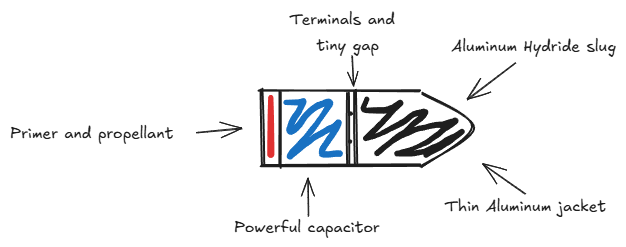
With these components in mind, the impact of the projectile is the final piece to the reaction. The capacitor's terminals face the Aluminum Hydride slug with only a hair's width gap between them. When the cartridge strikes a target and deforms, the terminals touch the Aluminum Hydride slug and instantly dump the entire stored charge of the capacitor into the slug, releasing all the stored hydrogen in the Aluminum Hydride and immedieately ionizing it, heating it to several thousand degrees Kelvin, and causing a localized plasma explosion. The size of the explosion is dependent on the charge of the capacitor and size of the Aluminum Hydride slug, so this explosion is entirely scaleable all the way up to rockets and bombs. Plasma cartridges are most ideal for use in the setting of TRACE due to the nature of the foes, the infestation can regenerate from small amounts of tissue so vaporizing the tissues instead of blowing them up and scattering them is preferred greatly. Plasma cartridges also have the advantage of having zero damage falloff; as long as there is enough energy in the projectile to deform the projectile just a little, the reaction will undergo and damage the target. The projectile can still lose velocity, but the damage characteristics are not affected by range.
There are variations of this technology, notably rocket propelled cartridges used to deliver larger payloads, and armor-piercing cartridges that use the Munroe effect. In an armor-piercing plasma cartridge, the Aluminum Hydride slug instead has a hollow conical shape that funnels plasma into a target instead of dispersing the reaction in a sphere around the moment of impact. This results in a directed beam of hot plasma that can pentrate farther into armor than a standard plasma cartridge.
Additional facts: With the invention of plasma cartridges and handheld railguns, necked ammunition is obsolete because there is practically no niche for a high-velocity plasma cartridge. The armor-piercing results of a plasma cartridge are dependent on the size, heat, and direction of the plasma reaction, not the shape, velocity, or material of the projectile. All plasma cartridges are straight-walled caseless ammuniton, and long-range roles use railguns instead. Automatic firearms are rare because plasma cartridges are caseless, which comes at the cost of causing more heat to build up in the weapon. Automatic weapons that use plasma cartridges require advanced cooling methods that are heavy, expensive, and may affect the reliability of the weapon. The sort of violence that calls for automatic weapons is rather rare within the megastructure anyway, they are simply not needed becasue the ability of semi-auto and manual-action weapons to vent heat between shots and use plasma cartridges yields a much higher overall damage than an automatic firearm using outdated cased ammuntion. Essentially, what damage an automatic weapon shooting cased ammunition and not plasma catridges can do in 10 hits, a plasma cartridge can do in one. Additionally, plasma cartridges are decently more expsenive than classic cased ammuniton, even with Ark's incredible amount of resources. Slowere rates of fire and manual actions encourage ammo conservation and good shot placement, while also reducing the potential of unforseen casualties by crossfire in urban areas. With caseless plasma cartridges being the norm in firearms, manual actions are very popular. Manual actions guarantee a steady rate of fire that keeps weapons from overheating, and in the event of overheating the weilder can easily vent the weapon by simply holding open the action for a few seconds.
Hunter Toolkit:
Okay I just want to say that designing satisfying weapons, gadgets, and systems is one of my favorite things about game design and this is something I put a TON of thought into. Eveything I describe here is for reasons and I'll probably end up going painfully in-depth about my thought processes here and there. I do want to detail my general design philosophy though; I like for weapons and tools to serve more than one function, flow with gameplay, have drawbacks, and fill a niche. Most things I list here will have these rules in mind, though sometimes the rules are bent a little for one reason or another. Also worth noting that a player would have access to all of their unlocked tools at any time, it's like Doom where the player can switch between any weapon on the fly. I've also got some reference images so you can see what shapes and styles are going through my head.
Sword
Hunter gets a techy single-edged plasma sword. A single strike deals very high damage ad it has a special long-range lunge. It's designed to be used as an extremely aggressive weapon AND movement tool, the lunge is like a long-range dash that'll get you from just about anywhere to in an enemy's face very quickly. It has no block function to keep its niche aggressive.

Pistol
The Pistol one of the two starting weapons alongside the sword. It does basic gun stuff, semi-automatic, shaped like many 21st century pistols. I went a little out of my way to make all the weapons fel satisfying, and that includes the Pistol, even if it's a starter weapon I want it to feel good and be useable for the entire duration of the game. It is actually semi-automatic to start with, it goes as fast as a player can tap. Like all other weapons in TRACE, it also has no damage falloff so single shots at range are still viable, but once other weapons are unlocked they'll do most things better than Pistol; the Shotgun will easily beat it close up, the Lever-Action will beat it in most areas, the Railgun beats it at long range easily. But it will always be easy to use and be tolerable at all tasks. It's niche essentially being a jack-of-all-trades, master of none. It's anemic output ensures other weapons will usually be the superior option.

Railgun
The Railgun is a long-range precision weapon that charges for 1-2 seconds and then fires a solid metal slug at many times the speed of sound. It then needs to cool down for another couple seconds before it can be charged again, but it will still cooldown if holding another weapon to keep combat smooth. It's good for both single target damage and light crowd control from safe distance but has a very low volume of fire.

Shotgun
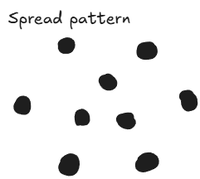
The Shotgun is a pump-action that fires specialized plasma cartridges, they split into 9 smaller pellets after exiting the barrel that can each cause a plasma detonation on impact.

Rocket Launcher
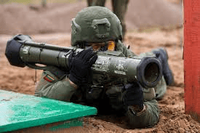
The Rocket Launcher fires oversized rocket-propelled plasma cartridges that do a ton of damage over a large radius. It shoots once before it must be reloaded and ammo is scarce. Its good for chunking heavy enemies or firing into a large crowd.
Lever-Action
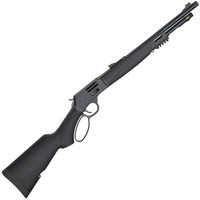
I put a lot of thought into this one. I really wanted a solution to mid-range volume of fire, its a really hard role to keep in its niche because it is inherently very generalist and kind of a nebulous role, it can do anything. There is a good reason that modern ARs are all so similar, its a very versatile platform. However, it doesn't cleanly fit into my design philosophy, so I got creative and I think came up with something I'm happy with. Partway through the game Hunter starts encountering armored enemies that take significantly less damage outside of their weak points. Hunter then obtains the Lever-Action, a lever-action plasma rifle that fires specialized plasma cartridges that can punch through armor or deal good damage to most targets, killing fodder in one hit and larger targets in more with a modifier against armor. It holds 10 plasma cartridges and can be partially reloaded at any time. A player using the weapon well can maintain sustained fire without having to endure a long full reload, or its damage can quickly be dumped into a single target and then reloaded. This weapon does stretch my rules about drawbacks and having a niche, but I think this is the best I can do for a mid-range volume of fire option. It has a couple things going for it indirectly, which as that it's only unlocked partway through the game so the player already has to learn how to use the standard toolkit before they get this reliable option, and that makes it feel more like a reward than a cheat. Also, it has major cool points for being lever-action in a science fiction setting.